Mortgage underwriting is the process a lender uses to determine if the risk (especially the risk that the borrower will default ) of offering a mortgage loan to a particular borrower is acceptable. Most of the risks and terms that underwriters consider fall under the three C’s of underwriting: credit, capacity and collateral. (In the UK they are known as the three canons of credit - capacity, collateral, and character.) To help the underwriter assess the quality of the loan, banks and lenders create guidelines and even computer models that analyze the various aspects of the mortgage and provide recommendations regarding the risks involved. However, it is always up to the underwriter to make the final decision on whether to approve or decline a loan. Critics have suggested that the complexity inherent in mortgage securitization can limit investors' ability to monitor ri...
In addition to the two standard means of setting the cost of a mortgage loan (fixed at a set interest rate for the term, or variable relative to market interest rates), there are variations in how that cost is paid, and how the loan itself is repaid. Repayment depends on locality, tax laws and prevailing culture. There are also various mortgage repayment structures to suit different types of borrower.
The most common way to repay a secured mortgage loan is to make regular payments toward the principal and interest over a set term. This is commonly referred to as (self) amortization in the U.S. and as a repayment mortgage in the UK. A mortgage is a form of annuity (from the perspective of the lender), and the calculation of the periodic payments is based on the time value of money formulas. Certain details may be specific to different locations: interest may be calculated on the basis of a 360-day year, for example; interest may be compounded daily, yearly, or semi-annually; prepayment penalties may apply; and other factors. There may be legal restrictions on certain matters, and consumer protection laws may specify or prohibit certain practices.
Depending on the size of the loan and the prevailing practice in the country the term may be short (10 years) or long (50 years plus). In the UK and U.S., 25 to 30 years is the usual maximum term (although shorter periods, such as 15-year mortgage loans, are common). Mortgage payments, which are typically made monthly, contain a repayment of the principal and an interest element. The amount going toward the principal in each payment varies throughout the term of the mortgage. In the early years the repayments are mostly interest. Towards the end of the mortgage, payments are mostly for principal. In this way the payment amount determined at outset is calculated to ensure the loan is repaid at a specified date in the future. This gives borrowers assurance that by maintaining repayment the loan will be cleared at a specified date, if the interest rate does not change. Some lenders and 3rd parties offer a bi-weekly mortgage payment program designed to accelerate the payoff of the loan.
An amortization schedule is typically worked out taking the principal left at the end of each month, multiplying by the monthly rate and then subtracting the monthly payment. This is typically generated by an amortization calculator using the following formula:
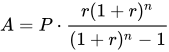
where:
- is the periodic amortization payment
- is the principal amount borrowed
- is the percentage rate per period divided by 100; for a monthly payment, take the Annual Percentage Rate (APR)/12/100
- is the number of payments; for monthly payments over 30 years, 12 months x 30 years = 360 payments.


The main alternative to a principal and interest mortgage is an interest-only mortgage, where the principal is not repaid throughout the term. This type of mortgage is common in the UK, especially when associated with a regular investment plan. With this arrangement regular contributions are made to a separate investment plan designed to build up a lump sum to repay the mortgage at maturity. This type of arrangement is called an investment-backed mortgage or is often related to the type of plan used: endowment mortgage if an endowment policy is used, similarly a Personal Equity Plan (PEP) mortgage, Individual Savings Account (ISA) mortgage or pension mortgage. Historically, investment-backed mortgages offered various tax advantages over repayment mortgages, although this is no longer the case in the UK. Investment-backed mortgages are seen as higher risk as they are dependent on the investment making sufficient return to clear the debt.
Until recently it was not uncommon for interest only mortgages to be arranged without a repayment vehicle, with the borrower gambling that the property market will rise sufficiently for the loan to be repaid by trading down at retirement (or when rent on the property and inflation combine to surpass the interest rate)
Recent Financial Services Authority guidelines to UK lenders regarding interest-only mortgages has tightened the criteria on new lending on an interest-only basis. The problem for many people has been the fact that no repayment vehicle had been implemented, or the vehicle itself (e.g. endowment/ISA policy) performed poorly and therefore insufficient funds were available to repay balance at the end of the term.
Moving forward, the FSA under the Mortgage Market Review (MMR) have stated there must be strict criteria on the repayment vehicle being used. As such the likes of Nationwide and other lenders have pulled out of the interest-only market.
A resurgence in the equity release market has been the introduction of interest-only lifetime mortgages. Where an interest-only mortgage has a fixed term, an interest-only lifetime mortgage will continue for the rest of the mortgagors life. These schemes have proved of interest to people who do like the roll-up effect (compounding) of interest on traditional equity release schemes. They have also proved beneficial to people who had an interest-only mortgage with no repayment vehicle and now need to settle the loan. These people can now effectively remortgage onto an interest-only lifetime mortgage to maintain continuity.
Interest-only lifetime mortgage schemes are offered by two lenders currently – Stonehaven & more2life. They work by having the options of paying the interest on a monthly basis. By paying off the interest means the balance will remain level for the rest of their life. This market is set to increase as more retirees require finance in retirement.
For older borrowers (typically in retirement), it may be possible to arrange a mortgage where neither the principal nor interest is repaid. The interest is rolled up with the principal, increasing the debt each year.
These arrangements are variously called reverse mortgages, lifetime mortgages or equity release mortgages (referring to home equity), depending on the country. The loans are typically not repaid until the borrowers are deceased, hence the age restriction.
Through the Federal Housing Administration, the U.S. government insures reverse mortgages via a program called the HECM (Home Equity Conversion Mortgage). Unlike standard mortgages (where the entire loan amount is typically disbursed at the time of loan closing) the HECM program allows the homeowner to receive funds in a variety of ways: as a one time lump sum payment; as a monthly tenure payment which continues until the borrower dies or moves out of the house permanently; as a monthly payment over a defined period of time; or as a credit line
For further details, see equity release.
In the U.S. a partial amortization or balloon loan is one where the amount of monthly payments due are calculated (amortized) over a certain term, but the outstanding balance on the principal is due at some point short of that term. In the UK, a partial repayment mortgage is quite common, especially where the original mortgage was investment-backed.
Graduated payment mortgage loan have increasing costs over time and are geared to young borrowers who expect wage increases over time. Balloon payment mortgages have only partial amortization, meaning that amount of monthly payments due are calculated (amortized) over a certain term, but the outstanding principal balance is due at some point short of that term, and at the end of the term a balloon payment is due. When interest rates are high relative to the rate on an existing seller's loan, the buyer can consider assuming the seller's mortgage. A wraparound mortgage is a form of seller financing that can make it easier for a seller to sell a property. A biweekly mortgage has payments made every two weeks instead of monthly.
Budget loans include taxes and insurance in the mortgage payment; package loans add the costs of furnishings and other personal property to the mortgage. Buydown mortgages allow the seller or lender to pay something similar to points to reduce interest rate and encourage buyers Homeowners can also take out equity loans in which they receive cash for a mortgage debt on their house. Shared appreciation mortgages are a form of equity release. In the US, foreign nationals due to their unique situation face Foreign National mortgage conditions.
Flexible mortgages allow for more freedom by the borrower to skip payments or prepay. Offset mortgages allow deposits to be counted against the mortgage loan. In the UK there is also the endowment mortgage where the borrowers pay interest while the principal is paid with a life insurance policy.
Commercial mortgages typically have different interest rates, risks, and contracts than personal loans. Participation mortgages allow multiple investors to share in a loan. Builders may take out blanket loans which cover several properties at once. Bridge loans may be used as temporary financing pending a longer-term loan. Hard money loans provide financing in exchange for the mortgaging of real estate collateral.
In most jurisdictions, a lender may foreclose the mortgaged property if certain conditions occur – principally, non-payment of the mortgage loan. Subject to local legal requirements, the property may then be sold. Any amounts received from the sale (net of costs) are applied to the original debt. In some jurisdictions, mortgage loans are non-recourse loans: if the funds recouped from sale of the mortgaged property are insufficient to cover the outstanding debt, the lender may not have recourse to the borrower after foreclosure. In other jurisdictions, the borrower remains responsible for any remaining debt.
In virtually all jurisdictions, specific procedures for foreclosure and sale of the mortgaged property apply, and may be tightly regulated by the relevant government. There are strict or judicial foreclosures and non-judicial foreclosures, also known as power of sale foreclosures. In some jurisdictions, foreclosure and sale can occur quite rapidly, while in others, foreclosure may take many months or even years. In many countries, the ability of lenders to foreclose is extremely limited, and mortgage market development has been notably slower.
Comments
Post a Comment